|
Physics 11x5 Laboratory 2025:
Introduction to Experimental Methods
Instructor(s):
All Lab Sections:
Siavash Sattar
Presser 2 x8605
ssattar AT
randolphcollege.edu
Office Hours:
Tuesdays and Fridays, 11-1 pm, or by scheduling an
appointment via email |
| Lecture: Peter
Sheldon
| Webb 101 x8488
|
434-238-5681
| psheldon AT randolphcollege.edu
|
Office Hours |
Time: Monday and Thursday 1:15-4:15
(Section 1115LA) or Tuesday and Friday 1:15 - 4:15 (Section 1115LB,
1105LA); Expect to be in lab the full period
each time we meet. You may well be out early sometimes, but this can never be
guaranteed, and you will be out late sometimes. Do not rush to get out
early, as this will be reflected in your grade.
Place: The lab is in Martin
208-N,
although at times we may announce a different venue.
|
 |
|
Week |
Day |
Lab# |
Lab |
Formal? |
|
1 |
Th, F |
0 |
Intro |
Notebook |
|
|
|
|
Statistics Intro |
|
|
|
M, T |
1 |
Statistics |
Individual |
|
|
|
|
reminder: lab notebook requirements |
|
|
2 |
Th, F |
2 |
Motion and Error |
Notebook |
|
|
|
|
Peer Review of Formal Lab 1 |
|
|
|
M, T |
3 |
Measure g |
Group |
|
3 |
Th, F |
4 |
Vector Addition |
Notebook |
|
|
|
|
Introduce vector multiplication |
|
|
|
M, T |
5 |
Projectile Motion |
Notebook |
|
4 |
Th, F |
6 |
Newton's Laws |
Oral |
|
|
M, T |
7 |
Centripetal Force |
Notebook |
|
|
|
|
Introduce centripetal force |
|
|
5 |
Th, F |
8 |
Friction |
Creative |
|
|
M, T |
9 |
Hooke's Law |
Notebook |
|
|
|
|
Introduce SHM |
|
|
6 |
Th, F |
10 |
Harmonic Motion |
Formal |
|
|
|
|
Continue SHM
Discuss Final Projects |
|
|
|
M, T |
11 |
Conservation of p&E |
Notebook |
|
|
|
|
Introduce Momentum
Statistics Review |
|
|
7 |
Th, F |
|
Work on projects |
Notebook |
|
|
|
|
presentation pointers |
|
| final
assessments (FCI, tech) |
|
|
M, T |
|
Presentations/course evaluations |
|
Laboratory Description:
The schedule of labs is above, and links to the lab are on the
left. The laboratory schedule is tentative and subject to change; you must
check the website no more than
one
lab meeting
prior to lab to determine the correct lab that will be done that day.
The physics laboratory is a mixture of pre-laboratory exercises, in-class
experiments, computer simulations, and lab reports. We are often upgrading and updating lab
equipment, computers, software and the web site, so changes may occur. Announcements
of changes in laboratories will be made during the previous lab.
Laboratory sessions will usually be preceded with class discussion or demonstration
explaining specific procedures to be followed. Laboratory exercises are designed to
complement the theory presented in class and as such are often a compromise between the
abstract world of point masses, frictionless tables and massless strings,
and the real world. Hopefully the labs you will perform will "work" and give
results in good agreement with the ideal. We are trying to reinforce the abstract concepts
of force, velocity, vectors, etc with some real everyday phenomena in order to make the
physics meaningful. That is the "cookbook" part of any laboratory-- I
often know what
the answer should be and I expect you to get reasonably close to it. Often you will
discover enough disagreement that you can make some intelligent observations as to the
cause of the discrepancy; this is where you can and should add your ideas as to what
caused the discrepancy, how you would improve the experiment, or how you would modify the
theory to give better agreement.
During the first few meetings of lab you will be given instruction in/be
learning about the use of the
computer and the use of statistics. Virtually no experimental science is done without the aid of a computer in
taking and analyzing data. They allow the rapid analysis of data and help reduce the time
and tedium of such routine tasks as tabulating and graphing. Computers have become a part
of professional practice in the sciences and you need to be exposed to their use.
There
are pitfalls however that will need to overcome: lost data due to crashed
computers, bugs in
programs or programmers, and a general computer-phobia among the uninitiated. Don't
be afraid of the computers. I will be happy to show you everything you need to know.
Objectives:
- Students will understand the function of research design and
experimentation.
- Students will understand the role and nature of theory explaining and
predicting events and phenomena.
- Students will be able to implement classroom and laboratory safety rules
and procedures and will take appropriate safety precautions.
- Students will engage in research projects and experiments that include the applications
of the design process and technology.
- Students will engage in problem-solving, and will
apply physics to solve practical problems.
- Students will understand the contributions of
physics to society, including its social, cultural, and economic
significance.
- Students will understand the
relationship of physics and other sciences to mathematics, the design
process, and technology
- In some of the labs, and as part of the final project, students will conduct systematic field investigations using the school grounds, the
community, and regional resources
- Each section of the text introduces another step or discovery in the
historical development of physics, so the student will understand
the historical development of scientific concepts and scientific
reasoning
Pre-Laboratory Assignments:
Each day before you get to lab, you should read the lab from the web and do
the pre-lab exercise. The pre-lab exercises can be found by going to the appropriate lab
on the lab web page. All solutions to pre-laboratory exercises need to be
submitted on Moodle at least 30 minutes prior to lab on
lab day and will be averaged as part or your laboratory grade for the course.
You will enter your answer to the question in Moodle, and it will be automatically graded. You can have
multiple tries to answer the question. For multiple choice questions, each try
will cost you a small amount of points, while for fill-in-the-blansk, multiple
tries are not penalized. Strict
adherence to turning this in prior to lab is necessary in order to ensure that you are as prepared as your lab
partners, they will not be accepted after 1:15 pm.
Lab Groups:
In the interest of working in teams, and replicating what you will experience
in industry, you will be assigned lab partners, and we will rotate each time we
do a formal lab. You may choose your own partners for the final formal lab and
final project. We will work in groups of 2-3, although it may differ for select
labs. Lab groups for Dr. Sheldon's section will be posted here.
Reports:
We will have formal and informal lab reports. The informal report is to be
completed satisfactorily before you leave the lab, in your lab notebook. It will
include purpose, all analysis of data, results, and conclusions. You must have
your lab notebook checked before you leave lab on informal lab days. The formal
reports are noted on the schedule of labs for the semester. Your formal lab
reports may come in different forms, such as oral reports, individual reports,
or group reports that consist of proper write-ups which are done outside of
class and submitted electronically. There are five formal reports in the
semester. These reports do not need to be extensive, but should be all-inclusive
and concise. Written write-ups are due on the next lab day. The
semester will culminate in an oral/multimedia presentation of a lab or research
project.
Formal report details: can be found here.
Grading rubric can be found
here.
Peer Review:
In order to make sure you understand what is required in a complete lab
report, we will do a class peer-review of Formal Lab Report 1 in lab as shown on
the syllabus.
Your formal lab will be read by your classmates. We will likely only do this
with the first lab, but reserve the right to do it with future labs if problems
persist. Each student's peer review will be graded as a pre-lab.
Notebook:
The laboratory notebook is the scientist’s most important tool. You must have a
dedicated lab notebook (do NOT also take class notes in it). This is meant to be
a real scientific lab notebook, so you should write anything related to the lab
in it: notes, data, analysis. A lab notebook must follow these guidelines:
-
Bound paper notebook with pockets or bound paper notebook in a 3 ring binder
- Name must be on the front cover (inside or out)
-
Do NOT tear out any pages
-
Do NOT erase text (it’s better to use pen)
-
All handouts and graded formal labs must be kept in pockets
-
All notes from formal labs must be included
-
All complete informal labs must be included
-
Keep the same notebook all semester (you can use it again in the spring)
Informal lab reports will be written legibly in these notebooks. You will also
need to print out and tape any relevant graphs into your lab notebook. This
is meant to be a real lab notebook - in scientific labs, everything must be kept
in one notebook, easy to follow chronologically. The
formal labs will be written up from the information contained in these
notebooks. You may re-use on old notebook that
was not filled from another class. You will need to save and use this lab
notebook if you are going on to a second semester physics lab. I can sell you a
notebook at cost, for $2.
Lab notebook sample rubric
here.
Computers:
We will not use computers to take data every time, although I expect that you will use
the computer to analyze data and write lab reports each time. We use the Vernier
computer interfaces to take data, Excel to analyze it, and
word-processing software to write up formal labs. We
will talk about them in lab, but hints
for how to use the hardware, software and how to present the write-up can be found on the
menu bar at the left.
Artificial Intelligence (AI):
You are prohibited from using AI to create data, to analyze data, or to write
your purpose, discussion, or conclusion sections. You may use AI to edit your
writing and to help to organize your lab report format, but if you do, you must
disclose that you have used AI within your lab report.
Attendance Policy:
You must attend lab! It is almost impossible to
make-up a lab without your lab partners, and there is so much going on in the physics lab
that we cannot leave the equipment out all the time. If you are going to miss
ANY labs, you should consider taking this lab another time, but ff you know that
you will have more than two labs missed, you should definitely not take this lab right now
and should take it another time when you can guarantee attendance.
- For any misses, you are still responsible to do the prelab by the original due date
and time.
- If you have an undocumented miss (you skip, oversleep, have a meeting that
you have scheduled during lab, or work hours that you have scheduled during lab,
for example), you receive a zero for that lab.
- If you have one documented miss (because you are on a sports team and
have a game, or you have a note from a doctor, associate provost, or
equivalent), you must get the data from your lab partners and write up the lab
as an informal lab, due the next lab period. If It was meant to be a formal lab,
you must instead writeup the next informal lab as a formal lab, due the
following lab period.
- If you have a second documented miss, you will need to make up the lab by
doing it on your own, and the writeup will be due the next lab period.
- Any further misses will receive zero whether documented or not.
Grading:
Each lab will be
on the web ahead of time, and you must read it and do any pre-lab
exercise before arriving in lab. Formal write-ups are graded on a
ten point scale. Pre-lab problems are graded on a ten point scale. Late labs will be penalized ten percent per day.
Final Presentation 18 points
Informal Labs 3 points each (approximately 6)
Lab Notebook 3 points - note that at least 1 point of each informal lab is
related to it being neatly and completely in the lab notebook, so lab notebook
is really worth more
Formal Write-Ups 10 points each (approximately 5)
Pre-Labs (and any other assignments) 1 point each (approximately 11)
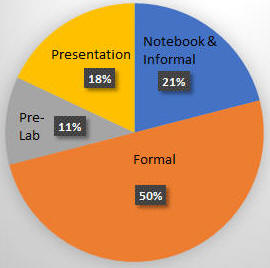
These points add to approximately 100. But if something changes, then the lab
grade is based on a different total, but each component's value remains the same
(e.g if an informal lab is cancelled because of a snow day, the lab grade is out
of a total of 97 instead of 100).
Phone Policy:
Smart phones are a proven distraction from learning. You will be expected to refrain from using your phone for non-laboratory
activities in class.
College-Wide Policy:
PDF Document Here
Department
of Physics